

 Liam Hartwell
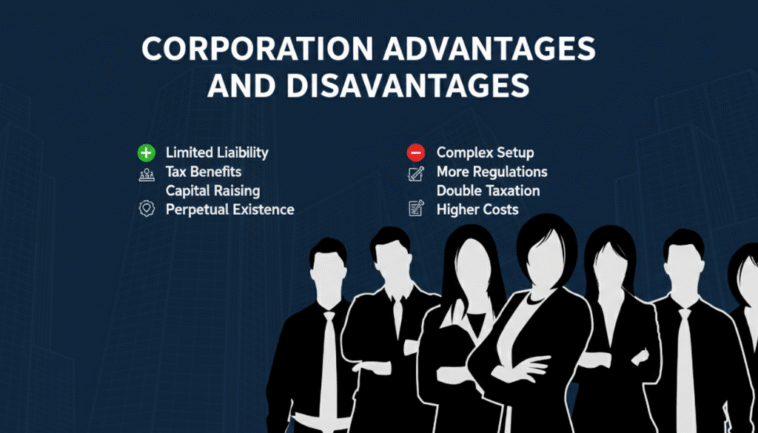
Choosing the right business structure is one of the most important decisions an entrepreneur will ever make. For many, the idea of forming a corporation sounds impressive and professional but it also comes with legal, financial, and operational responsibilities. Understanding corporation advantages and disadvantages is essential before committing to this business model.
A corporation is not just a bigger version of a small business. It is a legally distinct entity that offers powerful benefits like limited liability, easier access to capital, and long-term continuity. At the same time, it can involve higher costs, stricter regulations, and complex tax rules that may not suit every business owner.
This complete beginner’s guide breaks down everything you need to know about corporation advantages and disadvantages in clear, practical terms. You’ll learn how corporations work, their major benefits, potential drawbacks, real-world examples, and how they compare to other structures like LLCs and sole proprietorships. By the end, you’ll be equipped to decide whether forming a corporation aligns with your goals, budget, and risk tolerance.
What Is a Corporation?
A corporation is a legal business entity that exists separately from its owners, known as shareholders. This separation means the corporation can own property, enter contracts, sue or be sued, and continue operating regardless of changes in ownership.
Unlike informal business structures, corporations are created under state law and must follow strict governance rules. These include appointing directors, issuing shares, holding annual meetings, and maintaining corporate records.
Common characteristics of corporations include legal independence, limited liability protection, and the ability to raise capital through stock. Because of these features, corporations are widely used by medium-to-large businesses and companies planning long-term growth.
Types of Corporations You Should Know
Before analyzing corporation advantages and disadvantages, it’s important to understand that not all corporations are the same.
C Corporation (C-Corp)
This is the standard corporation structure. It is taxed separately from its owners and can have unlimited shareholders, including foreign investors.
S Corporation (S-Corp)
An S-Corp allows profits and losses to pass through to shareholders’ personal tax returns, avoiding double taxation. However, it has restrictions on ownership and share classes.
Nonprofit Corporation
Formed for charitable, educational, or social purposes, nonprofit corporations enjoy tax-exempt status but cannot distribute profits to owners.
Professional Corporation (PC)
Designed for licensed professionals such as doctors, lawyers, or accountants, this structure limits liability related to business operations.
Each type affects the balance of corporation advantages and disadvantages differently.
Major Advantages of a Corporation
1. Limited Liability Protection
One of the biggest advantages of a corporation is limited liability. Shareholders are generally not personally responsible for business debts or legal claims.
If the corporation faces bankruptcy or a lawsuit, personal assets like homes and savings are usually protected. This protection is stronger than in partnerships or sole proprietorships.
Practical insight: Investors prefer corporations because limited liability reduces personal risk.
2. Separate Legal Entity
A corporation exists independently from its owners. This separation creates credibility with customers, banks, and suppliers.
Contracts are signed in the company’s name, not the owner’s. This structure also allows ownership to change without disrupting operations.
Mini case note: Large brands survive leadership changes because the corporation itself continues to exist.
3. Easier Access to Capital
Corporations can raise money by issuing stock or attracting venture capital. This makes expansion, innovation, and scaling more achievable.
Banks and institutional investors are also more comfortable lending to corporations due to formal governance and transparency.
This advantage becomes critical for businesses with high growth ambitions.
4. Perpetual Existence
Unlike sole proprietorships, a corporation does not end when an owner leaves or passes away. Ownership can be transferred through shares.
This continuity supports long-term planning and makes succession easier.
Example: Family-owned corporations often last for generations.
5. Transferable Ownership
Shares of a corporation can be sold or transferred without affecting daily operations.
This flexibility benefits investors and founders planning future exits or partnerships.
6. Enhanced Business Credibility
Operating as a corporation signals stability and professionalism. Many clients, especially large organizations, prefer working with incorporated businesses.
This credibility can directly influence contracts, partnerships, and customer trust.
7. Tax Planning Opportunities
While corporate taxation can be complex, it also offers planning advantages. Corporations can deduct certain expenses, offer employee benefits, and retain earnings for growth.
S-Corps, in particular, provide pass-through taxation while retaining corporate structure benefits.
Key Disadvantages of a Corporation
Understanding disadvantages is just as important when evaluating corporation advantages and disadvantages.
1. Double Taxation (C Corporations)
C-Corps face double taxation. The corporation pays taxes on profits, and shareholders pay taxes again on dividends.
This can significantly reduce net income compared to pass-through structures.
Quick calculation:
If a corporation earns $100,000, corporate tax may apply first, followed by personal dividend taxes.
2. Higher Formation and Maintenance Costs
Forming a corporation costs more than setting up an LLC or sole proprietorship. Fees include incorporation, legal documentation, and compliance filings.
Ongoing costs may include accounting, legal services, and annual state fees.
3. Complex Regulations and Compliance
Corporations must follow strict rules, such as:
- Holding annual shareholder meetings
- Maintaining corporate bylaws
- Filing detailed reports
Failure to comply can result in penalties or loss of limited liability protection.
4. Extensive Record-Keeping Requirements
Detailed financial and operational records are mandatory. This administrative burden may overwhelm small businesses with limited resources.
5. Reduced Owner Control
Shareholders elect directors, and directors appoint officers. This layered structure can limit founders’ direct control.
As ownership spreads, decision-making may become slower and more political.
6. Increased Scrutiny
Corporations often face closer scrutiny from regulators, tax authorities, and investors.
Mistakes in reporting or governance can have serious legal consequences.
Corporation Advantages and Disadvantages Compared to Other Structures
Corporation vs Sole Proprietorship
A sole proprietorship is easy to start but offers no liability protection.
Corporations provide safety and scalability but require more effort and cost.
Best for:
- Sole proprietorship: freelancers, small local services
- Corporation: growth-oriented businesses
Corporation vs LLC
LLCs offer flexibility, pass-through taxation, and fewer formalities.
Corporations excel in fundraising, long-term growth, and stock issuance.
Decision tip:
Choose an LLC for simplicity, a corporation for expansion.
Who Should Consider Forming a Corporation?
A corporation may be the right choice if you:
- Plan to raise external funding
- Want strong liability protection
- Intend to scale nationally or globally
- Need business continuity beyond ownership changes
However, small lifestyle businesses may find the structure unnecessary.
Common Pitfalls to Avoid
- Incorporating too early without revenue
- Ignoring compliance requirements
- Choosing the wrong corporation type
- Underestimating tax obligations
Avoiding these mistakes preserves the advantages of a corporation.
Mini Summary: Pros and Cons at a Glance
Advantages:
- Limited liability
- Access to capital
- Professional credibility
- Long-term stability
Disadvantages:
- Double taxation
- Higher costs
- Regulatory complexity
Balancing these factors is essential before incorporation.
Conclusion
Understanding corporation advantages and disadvantages empowers entrepreneurs to make informed, strategic decisions. Corporations offer unmatched benefits in liability protection, credibility, capital access, and continuity. These strengths make them ideal for businesses with growth ambitions and long-term visions.
However, corporations are not universally suitable. Higher costs, strict compliance requirements, and potential double taxation can outweigh benefits for smaller operations. The key is alignment matching your business goals, risk tolerance, and resources to the right structure.
Before forming a corporation, consult legal and financial professionals to assess your specific situation. When used correctly, the corporate structure can be a powerful foundation for sustainable success.
FAQs
1. What are the main corporation advantages and disadvantages?
The main advantages include limited liability, access to capital, and business continuity. Disadvantages include double taxation, higher costs, and complex regulations.
2. Is a corporation better than an LLC?
A corporation is better for businesses seeking investors and scalability. An LLC is often better for small businesses wanting flexibility and simplicity.
3. Does a corporation protect personal assets?
Yes, corporations provide limited liability protection, meaning owners’ personal assets are usually protected from business debts and lawsuits.
4. Why do corporations pay double taxes?
C-Corporations pay corporate tax on profits, and shareholders pay personal tax on dividends, resulting in double taxation.
5. Can a small business be a corporation?
Yes, small businesses can incorporate, but they should evaluate whether the benefits outweigh the costs and compliance requirements.
6. What type of corporation is best for beginners?
An S-Corporation is often suitable for beginners due to pass-through taxation, but eligibility rules apply.
7. Are corporation advantages and disadvantages the same worldwide?
No, corporate laws and tax rules vary by country, affecting benefits and drawbacks significantly.