

 Ellis Vale
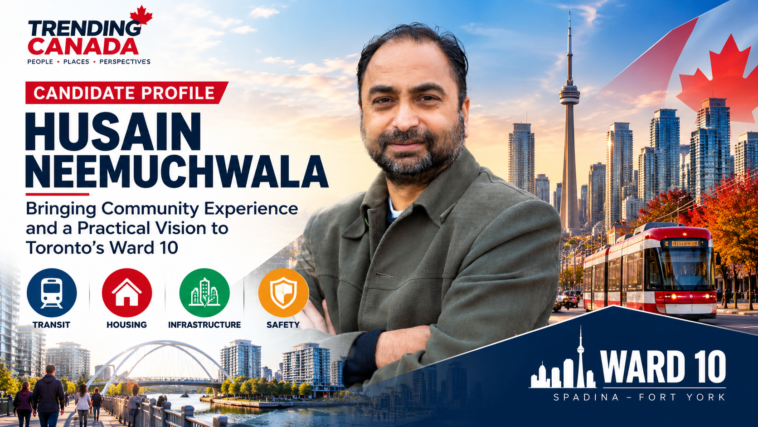
As Toronto prepares for its October 26 municipal election, entrepreneur and community advocate Husain Neemuchwala is seeking to represent Spadina–Fort York with a focus on transit, housing, infrastructure and neighbourhood safety.
By Trending Canada Editorial Desk | October 25, 2026
TORONTO — Behind Toronto’s growing skyline is a city experiencing pressures that are increasingly difficult for residents to ignore.
Housing remains expensive, construction projects disrupt daily commutes, public transit reliability continues to be debated, and many residents want their neighbourhoods to feel safer and better maintained.
These issues are particularly relevant in Spadina–Fort York, one of Toronto’s most densely populated and rapidly changing municipal wards.
As voters prepare to elect their next city councillor on October 26, Husain Neemuchwala, also known as Husain Neem, is among eight candidates seeking to represent Ward 10 at Toronto City Hall.
Neemuchwala enters the race with a background in international education, entrepreneurship, community engagement and previous political participation.
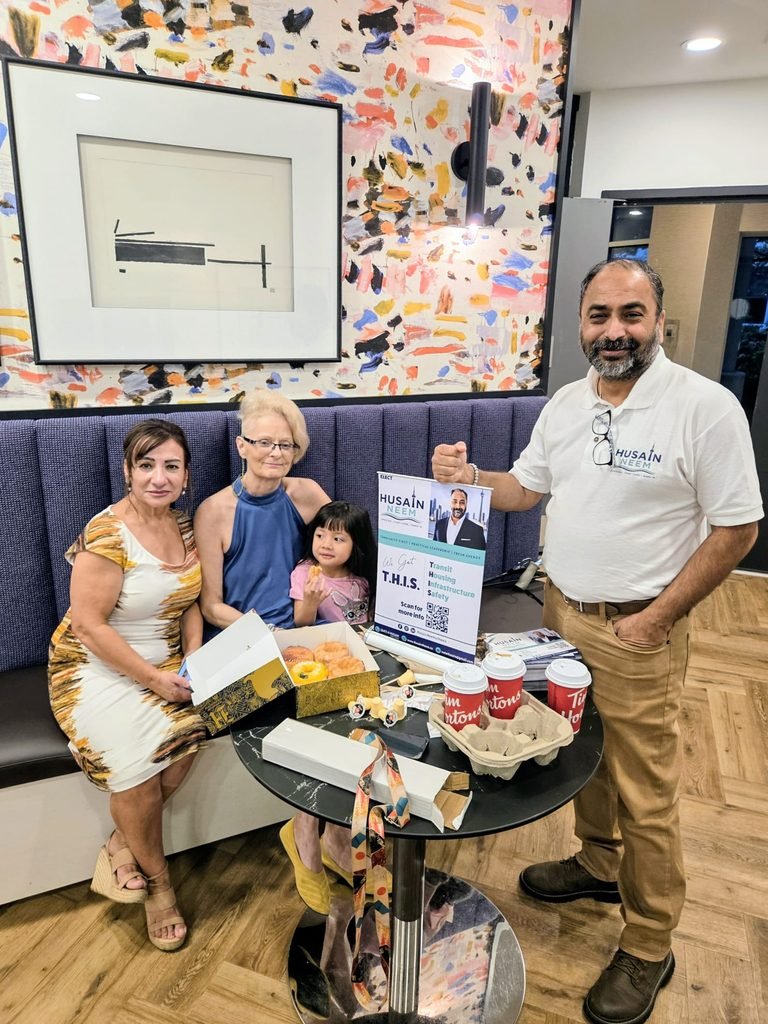
His campaign is built around a four-part agenda called T.H.I.S., representing Transit, Housing, Infrastructure and Safety.
The message is straightforward: as Toronto continues to grow, the quality of municipal services must keep pace with the people who depend on them.
But beyond the campaign slogan is a broader question facing voters: can his professional experience and community involvement translate into meaningful improvements in one of Canada’s most complex urban neighbourhoods?
From Entrepreneurship to Community Engagement
Neemuchwala’s professional journey has largely been associated with education, international partnerships and business development.
He has been involved in organizations connecting international students and education institutions, including the Canada India Education Council and Canada Campus Visits.
His work has included developing partnerships, facilitating educational opportunities and participating in initiatives connecting Canadian institutions with international communities.
According to his campaign biography, he has also spent years working with residents, local organizations, businesses and community groups on issues affecting everyday life.
The campaign describes more than a decade of community involvement, participation in over 100 community events and collaboration with more than 50 organizations. These figures are campaign-reported and have not been independently audited by Trending Canada.
His professional background is relevant to municipal politics because councillors must regularly work with different stakeholders, evaluate budgets, build relationships and negotiate competing priorities.
However, experience in business or community organizations is not automatically equivalent to experience managing public institutions.
Municipal government operates through legislation, public accountability, council decisions and budgetary limitations. The ability to navigate those systems is an important part of the job.
Neemuchwala’s candidacy presents voters with an opportunity to evaluate whether experience outside elected municipal office can bring useful perspectives to City Hall.
Not His First Experience in Politics
Although Neemuchwala is seeking a municipal council seat, he is not entirely new to electoral politics.
In Ontario’s 2022 provincial election, he represented the Progressive Conservative Party in Spadina–Fort York, finishing third behind the NDP and Liberal candidates.
That earlier campaign is a relevant part of his political background.
Unlike provincial elections, Toronto’s municipal council elections do not operate through official political party affiliations.
The responsibilities also differ considerably. A city councillor deals directly with municipal services, land-use decisions, city budgets, local transportation and neighbourhood concerns.
His current campaign emphasizes practical local issues rather than presenting itself as a continuation of a provincial party platform.
For voters, his previous candidacy provides additional context about his political experience, while his municipal proposals should be judged on their own merits.
Understanding the Community He Wants to Represent
Ward 10 includes communities such as Liberty Village, CityPlace, Fort York, King West, Chinatown, the waterfront and surrounding downtown neighbourhoods.
Despite their differences, these communities share challenges associated with population growth, development and increasing demands on public infrastructure.
According to Toronto’s 2021 Census ward data, Spadina–Fort York had approximately 135,400 residents, an increase of 18.4% from 2016.
Approximately 58% of households rented their homes, while around 88% of occupied dwellings were located in apartment buildings of five or more storeys.
Those numbers help explain the political importance of housing stability, transit access, pedestrian infrastructure and shared public spaces.
Many residents live in high-density developments where access to reliable transportation, green space, schools, community services and neighbourhood amenities can influence their quality of life.
Growth can create economic opportunities, but it can also put pressure on existing infrastructure.
For Ward 10 residents, the question is not simply how many new buildings appear on the skyline. It is whether neighbourhoods remain functional, affordable and welcoming as development continues.
That is the challenge Neemuchwala’s campaign says it wants to address.
The T.H.I.S. Plan: Four Priorities for Ward 10
Neemuchwala has structured his platform around four connected issues rather than an extensive collection of unrelated commitments.
Transit: Making Daily Movement More Reliable
Transportation is one of the most visible challenges facing downtown Toronto.
Streetcar delays, road closures, construction congestion and crowded transit routes can affect the daily routines of residents and workers.
Neemuchwala’s campaign calls for more dependable TTC services, improved transit accessibility, better coordination of construction projects and more practical transportation planning.
In responses published through the Toronto Public Library’s Know Your Vote initiative, he also proposed freezing TTC fares to reduce financial pressure on transit users.
He has advocated for improved traffic signal coordination, stronger enforcement against intersection blocking and measures that help public transit move more reliably.
The approach attempts to address the needs of pedestrians, cyclists, transit passengers and drivers together.
However, a city-wide fare freeze or major transit improvement would require broader decisions involving council, the TTC and municipal finances.
Voters should consider how Neemuchwala would build support for his proposals and whether the necessary funding could be secured without compromising services.
Housing: Growth That Supports Existing Residents
The affordability challenge is particularly significant in a ward where renters form the majority of households.
Neemuchwala’s campaign emphasizes attainable housing, stronger housing stability, family-friendly development and ensuring that residential construction is accompanied by necessary public services.
He has also expressed support for affordable and supportive housing, partnerships involving City-owned land and assistance for tenants experiencing financial difficulties.
In his Toronto Public Library questionnaire, he referred to supporting rent-bank assistance for residents facing housing instability.
Toronto already operates a Rent Bank program that offers grants to eligible residents who are behind on rent or need help with a rental deposit.
An important question, therefore, is whether Neemuchwala intends to expand existing assistance, improve access to it or pursue additional forms of support.
His broader argument is that housing policy should consider more than the number of units being constructed.
A neighbourhood also requires transportation, parks, community services and housing options suitable for different household sizes.
Turning that principle into results would require specific policy choices, funding priorities and cooperation with other levels of government.
Infrastructure: Keeping Pace With Development
Toronto’s downtown neighbourhoods have undergone considerable transformation.
But new residential and commercial development can create challenges when surrounding infrastructure does not expand at the same pace.
Neemuchwala’s infrastructure proposals include better construction coordination, more reliable road and sidewalk maintenance, improved sanitation, and greater investment in accessible parks and community spaces.
His campaign also emphasizes the challenges of high-density living and the importance of neighbourhood amenities.
These proposals address issues that might appear minor compared with major city projects but directly influence daily life.
A poorly maintained sidewalk, inaccessible public space or repeated construction disruption can have consequences for residents, businesses and people with mobility challenges.
The test for any councillor is whether such concerns can be prioritized and resolved through established municipal processes.
Residents should look for clear service standards, realistic timelines and transparent reporting on improvements.
Safety: Addressing Both Prevention and Community Well-Being
Safety is another central part of Neemuchwala’s platform.
His campaign calls for better lighting, safer pedestrian crossings, improved transit environments and neighbourhood-specific responses to public safety concerns.
He also supports stronger cooperation among municipal services, community organizations, police and crisis-response programs.
In his public candidate questionnaire, Neemuchwala emphasized better reporting mechanisms for hate incidents and stronger support for communities experiencing hostility or discrimination.
His approach recognizes that safety involves more than police enforcement alone.
Street design, public maintenance, mental health resources, community outreach and access to appropriate services also influence how residents experience their neighbourhoods.
The challenge is determining which initiatives are most effective, how they would be funded and what evidence would be used to measure their outcomes.
The Importance of Accessibility and Accountability
One of the recurring themes in Neemuchwala’s public messaging is that municipal representatives should remain accessible to the people they serve.
His campaign highlights neighbourhood conversations, community events and opportunities for residents to speak directly with him.
In his Know Your Vote responses, he also discusses developing measurable goals and reporting progress openly.
That commitment is relevant because the work of a city councillor continues long after election day.
Residents may need assistance navigating municipal departments, understanding development proposals, raising safety concerns or resolving problems with public services.
Effective representation requires listening, communicating clearly and knowing how to bring different parties together.
Accessibility, however, must be more than a campaign promise.
A useful measure of an elected representative is whether residents can receive timely responses, understand decisions affecting their neighbourhood and see evidence of progress on promised priorities.
Representation Beyond Background and Identity
Toronto is home to people from different cultures, religions, languages and walks of life.
That diversity is reflected in its businesses, neighbourhoods and public institutions.
Neemuchwala’s experience working across education and international communities is part of his background, but voters should examine his candidacy through the wider responsibilities of municipal office.
A councillor represents everyone within the ward, regardless of whether they share the councillor’s heritage, beliefs or political preferences.
The same standard should apply to every candidate.
An individual should neither receive automatic support because of a familiar background nor face rejection because of an unfamiliar one.
The more meaningful questions concern competence, integrity, public service, accountability and the ability to make sound decisions.
For Ward 10, that means evaluating how each candidate would represent renters and homeowners, families and individuals, established businesses and new entrepreneurs, young residents and seniors.
The interests of these groups may sometimes differ. Municipal leadership requires balancing them fairly.
What Voters Should Consider Before Election Day
Neemuchwala is competing in an eight-candidate race that includes incumbent councillor Ausma Malik and other challengers presenting their own approaches to municipal government.
Voters therefore have multiple choices and competing records or proposals to examine.
Neemuchwala’s T.H.I.S. framework identifies four areas relevant to Ward 10. His public questionnaire also provides additional detail on particular policies.
At the same time, important implementation questions remain.
How would transit fare commitments be financed? Which housing measures could be advanced through council? What improvements would receive priority in the municipal budget? How would the effectiveness of safety and infrastructure initiatives be measured?
These are reasonable questions for voters to ask, not only of Neemuchwala but of everyone seeking public office.
Municipal leadership is not simply about recognizing problems. It is about understanding what government can realistically do, securing support for decisions and remaining accountable when progress is slower than expected.
For undecided residents, comparing proposals against the actual responsibilities of City Council is a more useful exercise than relying solely on campaign slogans.
A Decision About the Future of Spadina–Fort York
Toronto’s October 26 election comes at a time when many residents are looking for practical improvements in everyday life.
They want dependable services, housing stability, safe neighbourhoods and confidence that public resources are being used responsibly.
Husain Neemuchwala is seeking to address these concerns through a campaign that draws on his business experience, community involvement and a four-part municipal agenda.
His candidacy adds another perspective to the conversation about how Spadina–Fort York should be represented during the next council term.
The final decision belongs to Ward 10 residents.
They must determine which candidate offers the most credible combination of experience, practical proposals, judgment and accountability.
Beyond the outcome of any individual campaign, the larger responsibility remains the same.
The people elected to City Hall must serve the entire community, including residents who supported other candidates.
Because the real measure of municipal leadership is not how successfully someone campaigns for office.
It is what changes for residents once the election is over.
Toronto Municipal Election 2026
Election Day: Monday, October 26, 2026
Voting hours: 10 a.m. to 8 p.m.
Position: Toronto City Councillor, Ward 10 — Spadina–Fort York
Candidate featured: Husain Neemuchwala (Husain Neem)
Official candidate website: https://husainneem.ca/
Official voting information: https://www.toronto.ca/city-government/elections/
Editorial disclosure: This article is an independent candidate profile based on published campaign materials, public election information and external reporting. Candidate commitments are not guarantees of future outcomes. Inclusion does not constitute an endorsement. Readers are encouraged to review every candidate in Ward 10 before voting.