

 Ellis Vale
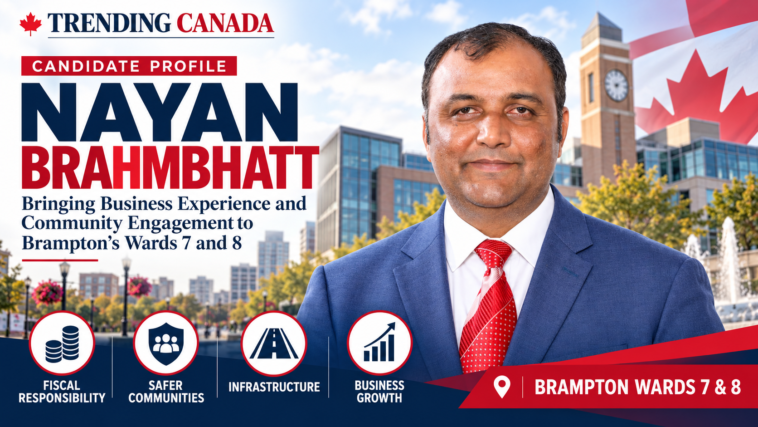
As Brampton prepares for its October 26 municipal election, strategic consultant, entrepreneur and community leader Nayan Brahmbhatt is seeking to represent Wards 7 and 8 with a campaign focused on financial accountability, neighbourhood safety, infrastructure and economic opportunity.
By Trending Canada Editorial Desk | October 25, 2026
BRAMPTON, ONTARIO — Brampton is a city shaped by ambition.
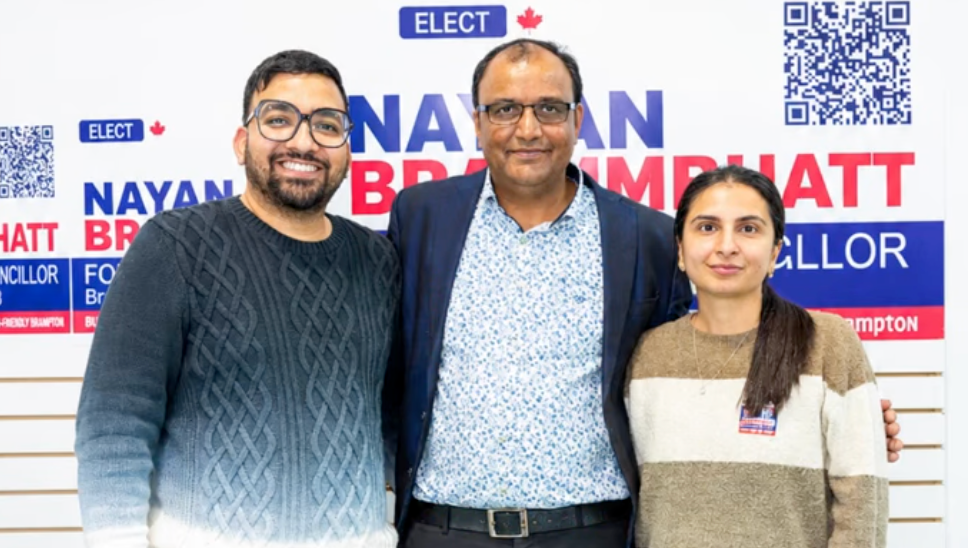
For decades, families have chosen to build their futures here. Entrepreneurs have opened businesses, newcomers have established roots, and neighbourhoods have grown alongside the city’s expanding economy.
Yet for many residents, that sense of opportunity is increasingly accompanied by questions about affordability, infrastructure, traffic congestion and the cost of maintaining a household.
Small business owners are balancing rising operating expenses with the need to remain competitive. Families are navigating housing costs and everyday financial pressures. Residents are questioning whether roads, public transportation and community services are keeping pace with development.
These are challenges that municipal candidates will inherit after the October 26 election.
Among those seeking a place at the decision-making table is Nayan Brahmbhatt, a Brampton entrepreneur, strategic consultant and community volunteer running for City Councillor in Wards 7 and 8.
Brahmbhatt’s professional background differs from that of a career municipal politician.
His work has included financial services, international trade, investment advisory, immigration-related business services and institutional partnerships.
He has also participated in community organizations, business networks and civic initiatives.
His campaign brings those experiences together under a central proposition: Brampton should become more business-friendly while remaining financially responsible, safe and responsive to its residents.
The question for voters is how those professional experiences and stated priorities would translate into decisions affecting their neighbourhoods.
A Professional Journey Rooted in Business and Finance
Brahmbhatt describes himself as a strategic consultant and business advisor with more than two decades of experience in business development, international expansion and financial services.
According to his published biography, he has worked with businesses, investors and organizations seeking to establish partnerships, expand into new markets and navigate commercial opportunities.
His campaign materials identify him as the president of ANB Immigration Services and the owner of ANB Mortgages in Canada.
Independent reporting by The Local also identifies his experience operating a mortgage brokerage and previously working as a mortgage advisor at CIBC, based on his professional profile.
His background in financial services is relevant to the discussion surrounding affordability, although the responsibilities of a municipal councillor are different from those of a mortgage professional or business advisor.
A financial services background can offer familiarity with borrowing, investment decisions and the pressures faced by individuals or businesses making long-term financial commitments.
Municipal government, however, involves public finance rather than private commercial decisions.
Councillors must evaluate tax-supported services, municipal budgets, long-term infrastructure obligations and competing demands from residents.
The experience may provide a useful perspective, but voters should examine how Brahmbhatt proposes to apply it within the legal and financial responsibilities of City Council.
Connecting Brampton With International Business Opportunities
A substantial part of Brahmbhatt’s professional biography concerns his involvement in international trade and commercial partnerships.
His campaign describes participation in business delegations and trade missions involving Canada, India, the United States, the United Arab Emirates, Australia and other markets.
He reports attending the Vibrant Gujarat Global Summit in 2018 and 2024 as part of Canadian business delegations and participating in meetings involving business associations and government representatives.
His biography also describes involvement in investment discussions, institutional partnerships and opportunities connecting Canadian enterprises with international markets.
In 2026, Brahmbhatt says he participated in a delegation involving meetings with political and business leaders in India to discuss economic cooperation.
These accounts are presented in his campaign materials and do not, by themselves, establish that specific investments or jobs were secured for Brampton.
Nevertheless, they help explain the economic-development perspective he brings to the election.
Municipal governments increasingly participate in investment attraction, business development and efforts to strengthen their local economies.
Brampton already has economic development programs intended to support businesses and encourage investment.
The practical question is how a city councillor could use professional networks or commercial knowledge to support those existing efforts.
New investment can offer opportunities, but public officials must also consider transparency, fair procurement, municipal planning rules and whether proposed projects provide measurable benefits to residents.
For Brahmbhatt, connecting international business experience with local economic development is one of the central themes of his candidacy.
Community Engagement Beyond Professional Life
Brahmbhatt’s public biography also emphasizes participation in community organizations and volunteer activities.
He currently identifies himself as president of the Gujarati Group of Brampton, an organization involved in cultural engagement and community programs.
His campaign lists involvement with the Indo-Canada Chamber of Commerce, the Brampton School Traffic Safety Council and other civic and professional organizations.
According to his biography, he has volunteered with initiatives associated with BAPS Charities and the Toronto 2015 Pan Am Games.
His campaign also describes community support work during the COVID-19 pandemic.
Brahmbhatt reports helping distribute more than 500 meals to international students and other community members, participating in vaccination-related initiatives and assisting individuals facing emergencies.
These activities are reported by the candidate and have not all been independently verified by Trending Canada.
They are nonetheless part of the record he has presented to voters.
Community organizations frequently encounter problems that fall outside the boundaries of a single government department.
They may provide assistance to people struggling with settlement, employment, financial hardship or social isolation.
Participation in such initiatives can expose volunteers to problems that are not always visible through formal policy discussions.
The question for voters is how that experience would influence decisions about city services, neighbourhood priorities and the allocation of municipal resources.
Previous Political and Civic Involvement
Although Brahmbhatt is seeking a seat on Brampton City Council, his involvement with political and civic institutions predates the current campaign.
His biography states that he previously served on a mayoral business ambassador panel in Brampton and participated in public policy discussions involving economic development and immigrant communities.
He also reports having served on the National Constitution Committee of the Conservative Party of Canada and participating in federal and provincial election campaigns.
This history is relevant context for voters.
Ontario’s municipal elections do not operate through formal political party affiliations in the same manner as federal or provincial elections.
A city councillor is elected to represent the residents of a municipal ward pairing, not a federal or provincial political party.
Brahmbhatt’s previous political involvement may have provided exposure to policy development, campaigns and political institutions.
At the same time, voters should judge his present candidacy on the responsibilities of municipal office and the proposals he has put forward for Brampton.
Understanding the Communities of Wards 7 and 8
Wards 7 and 8 include established residential neighbourhoods, commercial areas and communities experiencing ongoing development pressures.
Although the wards are represented together on City Council, their neighbourhoods and socioeconomic characteristics are not identical.
Reporting by The Local identifies differences in household incomes and local demographics between the two wards.
Those distinctions matter when considering municipal priorities.
Residents may share concerns about transportation, public services and safety while experiencing them differently depending on where they live and work.
A business owner may be concerned about access to customers and commercial property costs.
A parent may place greater emphasis on pedestrian safety, parks and recreation facilities.
A senior may be more concerned about accessible transportation and the maintenance of neighbourhood services.
Young people may be seeking local employment opportunities or reliable ways to reach school and work.
Effective representation requires taking these different experiences into account.
Brahmbhatt is one of seven certified candidates seeking the City Councillor position for Wards 7 and 8.
His campaign identifies four central priorities.
Four Priorities at the Centre of His Campaign
Rather than publishing a lengthy policy document, Brahmbhatt’s campaign website presents four broad commitments under its vision for a more business-friendly Brampton.
They are fiscal responsibility, safer communities, traffic and infrastructure improvements, and local economic growth.
1. Fiscal Responsibility: Making Public Spending Accountable
The first priority is financial accountability.
Brahmbhatt argues that municipal resources should be managed responsibly and that public spending should be subject to scrutiny.
This issue connects directly with a concern facing many households: the affordability of living in Brampton.
Property taxes support important municipal services, including infrastructure, transit, recreation, emergency services and local administration.
Residents understandably want to know whether their tax dollars are being spent effectively.
However, municipal budgeting is not simply a question of reducing spending.
Councillors must also consider the costs of maintaining roads, operating transit, supporting public facilities and replacing aging infrastructure.
Deferring necessary investment can sometimes create larger expenses in the future.
Brahmbhatt’s campaign states its commitment to eliminating waste and accounting for public expenditure.
What remains to be established is how he would identify inefficient spending, which services he would prioritize and how any proposed savings would be calculated.
These details would help voters distinguish a broad fiscal commitment from a specific financial plan.
2. Safer Communities: Addressing Residents’ Concerns
Public safety is Brahmbhatt’s second major priority.
His campaign calls for protecting families and improving residents’ sense of security.
Safety is an issue that can influence how people experience their neighbourhoods.
Residents may be concerned about crime, dangerous driving, poorly maintained public areas or whether children can travel safely to school and recreation facilities.
However, municipal safety responsibilities are shared across different institutions.
Peel Regional Police operates at the regional level, while the City of Brampton has responsibilities involving municipal by-laws, local road safety, parks, lighting, fire services and other public infrastructure.
A city councillor can raise concerns, advocate for improvements and participate in decisions within municipal authority.
They cannot independently direct every aspect of policing or guarantee particular crime outcomes.
Brahmbhatt’s published priority is broad.
Voters should examine whether he proposes specific measures involving safer intersections, better street lighting, stronger by-law enforcement, prevention initiatives or cooperation with regional partners.
Identifying which safety problems require attention, and which institution can address them, is an important part of evaluating any candidate’s proposal.
3. Traffic and Infrastructure: Managing a Growing City
Traffic congestion and transportation infrastructure are another focus of Brahmbhatt’s campaign.
As Brampton continues to develop, residents depend on roads, public transportation and pedestrian infrastructure to reach employment, education and essential services.
Traffic congestion can affect both personal schedules and business activity.
A delayed commute may mean additional childcare expenses, missed appointments or less time at home.
For commercial operators, unreliable travel times can affect deliveries, staffing and customer access.
Brahmbhatt’s campaign calls for reducing gridlock and improving infrastructure planning.
These are objectives with direct local relevance.
However, major transportation projects frequently require long-term investment, technical planning and coordination with other government bodies.
Not all roads are under City of Brampton control, and some projects require provincial or regional involvement.
City councillors can influence municipal road improvements, transportation planning and Brampton Transit priorities through council decisions.
For voters, the questions include which intersections or routes Brahmbhatt considers most urgent, what improvements he would propose and how those projects would be funded.
Better transportation planning requires more than recognizing congestion. It requires identifying workable measures that balance road capacity, public transit, pedestrian safety and future development.
4. Supporting Small Businesses and Local Economic Growth
The fourth priority is closely connected to Brahmbhatt’s professional background.
His campaign calls for a more business-friendly Brampton that attracts investment, encourages entrepreneurship and supports local economic activity.
Small businesses contribute to neighbourhood employment, commercial activity and the character of the city.
Restaurants, retailers, professional service providers, trades, manufacturers and other businesses are part of Brampton’s economic network.
These enterprises may face challenges involving municipal approvals, commercial space, infrastructure, staffing and operating costs.
Municipal governments cannot control every factor affecting business conditions.
Interest rates, national taxation, international trade conditions and broader economic trends fall largely outside the direct authority of City Council.
Nevertheless, municipal decisions concerning zoning, permits, infrastructure, public procurement and economic development programs can influence the local business environment.
Brahmbhatt’s campaign argues for supporting these opportunities.
Specific measures would make the approach easier to evaluate.
Would he focus on simplifying administrative processes, improving access to existing business support programs, attracting commercial investment or strengthening partnerships between employers and training institutions?
There is also the question of how new investment would benefit residents.
Economic development is not only about announcing projects or attracting capital.
Its local effects can be examined through business activity, employment opportunities, infrastructure needs and the long-term sustainability of municipal investment.
Business Experience and the Responsibilities of Public Office
Brahmbhatt’s professional and political experience is a central part of how he presents himself to voters.
But an important distinction exists between running a business and serving in government.
In business, organizational decisions are generally made within established ownership, management and regulatory structures.
In municipal government, elected representatives must work through public processes, debate with other councillors, consider staff recommendations and explain how decisions affect the wider community.
A city councillor cannot independently approve major spending, change municipal tax policy or implement every campaign commitment.
Such decisions frequently require council approval and, in some cases, cooperation with regional or provincial institutions.
Public office also creates obligations concerning conflicts of interest, disclosure and the separation of private interests from public responsibilities.
These requirements apply to all elected representatives, including those with professional backgrounds in business, real estate or financial services.
Brahmbhatt’s experience may inform how he approaches economic development and financial decisions.
The relevant question is how he would apply that experience while meeting the accountability and transparency requirements of public office.
Representation Beyond Cultural and Community Boundaries
Brampton is a city shaped by people from many different backgrounds.
Cultural and community organizations play an important role in bringing residents together, supporting charitable initiatives and maintaining traditions.
Brahmbhatt’s involvement in the Gujarati community and immigrant-focused organizations forms part of his public biography.
That experience may provide insight into the needs of particular residents.
However, the responsibilities of an elected city councillor extend to everyone living in the ward pairing.
A councillor must represent residents regardless of language, religion, ethnicity, caste, birthplace or political preference.
A candidate’s cultural identity should neither be treated as an automatic qualification nor as a reason for exclusion.
The relevant standard is whether a person is prepared to listen fairly, make accountable decisions and serve the broader public.
For a city as diverse as Brampton, this principle is particularly important.
Neighbourhood issues often affect people across cultural and economic backgrounds.
Road safety, municipal budgets, infrastructure maintenance and access to public services are shared concerns.
Candidates should therefore be examined not only through the communities in which they are active, but through their understanding of the entire municipality.
What Remains Unanswered in His Campaign Platform?
Brahmbhatt’s published priorities identify several subjects within the responsibilities of municipal government.
They also leave questions that voters may want answered before making their decision.
The campaign emphasizes fiscal responsibility, but does not publish a detailed municipal budget proposal or identify specific spending reductions on its priorities page.
It calls for safer communities without setting out a comprehensive list of public safety initiatives.
Its transportation commitments emphasize traffic and infrastructure improvements, but do not identify a detailed schedule of proposed projects.
And while local economic development is a central theme, the public platform does not set measurable targets for business growth or municipal investment.
These omissions do not necessarily mean proposals are absent from other campaign conversations or materials.
They do mean that the publicly accessible priorities page provides limited information about implementation, costs and timelines.
This is a distinction worth making.
Candidates frequently publish broad objectives to communicate their priorities. Those objectives become more informative when accompanied by details about authority, costs, expected outcomes and public accountability.
The same standard should be applied to all seven candidates.
Seven Candidates, One City Council Seat
The race for City Councillor in Wards 7 and 8 includes seven certified candidates:
- Nayan Brahmbhatt
- Taran Chahal
- Ripudaman Singh Dhillon
- Ayanna Kahlon
- Ali Khan
- Rakesh Sharma
- Monica Singh Soares
The position is currently held by Rod Power, who is seeking election as a regional councillor in the same ward pairing.
The candidates bring different professional backgrounds and approaches to local issues.
Residents can examine their records, campaign information and public statements to understand how their priorities compare.
For undecided voters, one useful approach is to focus on the municipal issues that most directly affect their daily lives.
What would each candidate do about road safety and traffic congestion?
How would they handle municipal spending?
What is their position on infrastructure development?
How would they communicate with residents between elections?
And how would they respond when the interests of different neighbourhoods or groups conflict?
A local election is an opportunity to ask practical questions about the services and decisions residents will live with for the next four years.
A Decision About Brampton’s Future
Nayan Brahmbhatt enters the 2026 municipal election with a professional background in financial services, business consulting and international commercial partnerships.
His published biography also describes involvement in community organizations, volunteer activities and political institutions.
His campaign is organized around four broad priorities: fiscal responsibility, public safety, transportation infrastructure and economic growth.
Together, these issues form the basis of his case for representation at City Hall.
The remaining questions concern the details of implementation, the costs of proposed changes and how he would work with other councillors and public institutions to advance those priorities.
For Brampton residents, those questions are part of a larger election conversation.
Municipal government affects daily life in ways that are not always obvious until something goes wrong: when traffic becomes unmanageable, when a neighbourhood lacks public amenities, when a business faces administrative delays or when public infrastructure fails to keep pace with growth.
Candidates may bring experience from business, community service, public administration or previous elected positions.
Each background offers a different perspective.
But the responsibilities of public office require more than professional experience or a recognizable name.
They require participation in collective decisions, financial accountability, an understanding of municipal authority and a commitment to serving residents with different needs.
As Brampton prepares to vote on October 26, the task for residents is to examine the proposals, question the commitments and decide which approach reflects their priorities for Wards 7 and 8.
The election will determine who occupies the council seat.
The years that follow will show how campaign priorities are translated into public decisions.
Brampton Municipal Election 2026
Election Day: Monday, October 26, 2026
Voting Hours: 10 a.m. to 8 p.m.
Position: City Councillor — Wards 7 and 8
Candidate Featured: Nayan Brahmbhatt
Official Campaign Website: https://nayanbrahmbhatt.ca/
Campaign Priorities: https://nayanbrahmbhatt.ca/my-priorities/
Official Election Information: https://www.brampton.ca/bramptonvotes
Eligible voters can vote at any designated voting location within their ward on October 26. Voters who have not received a voter notice can still vote by bringing acceptable identification showing their name and Brampton address.
Editorial disclosure: This article is part of Trending Canada’s independent Ontario Municipal Election 2026 candidate profile series. Candidate biographies, professional experience, volunteer activities and campaign commitments have been attributed to their respective public sources. Inclusion does not imply electoral endorsement, and campaign promises should not be interpreted as guaranteed outcomes. Readers are encouraged to examine all candidates before voting.